
GREEN COMPOUNDS – Sustainable Plastic Compounds
Sustainability at SITRAPLAS
The efficient use of resources is an integral part of SITRAPLAS’s business practices.
With its GREEN COMPOUNDS, the company offers sustainable plastic compounds that, depending on the product design, consist entirely or partially of:
- recycled raw materials (post-industrial / post-consumer)
- or bio-based materials
are manufactured. The specific material proportions and properties depend on the product and application.
Development and Material Optimization
The development of GREEN COMPOUNDS is an ongoing process that focuses on material and processing properties.
Where technically feasible and evaluable based on data, environmental aspects are also taken into account.
The goal is to provide materials that, depending on the application, can help reduce resource consumption and lower greenhouse gas emissions.
Assistance with Material Selection
SITRAPLAS assists customers in selecting suitable materials for their applications.
Upon request, information on the carbon footprint of individual plastic compounds is provided, provided that the relevant data is available.
Technical Center for Real-World Testing
At our in-house technical center, materials and processes can be tested under real-world conditions.
This enables an application-oriented evaluation of materials and processing parameters.
Approaches to Resource Conservation in Plastics Production
The following measures are part of our ongoing efforts to promote resource efficiency and sustainability:
- Taking CO₂ emissions into account as early as the product development stage (project-specific, data-dependent)
- Use of electricity from renewable energy sources (depending on location and contract)
- Use of recycled plastics from post-industrial and post-consumer streams (depending on the product)
- In-house processing and reuse of suitable production waste
- Use of bio-based additives, provided they are technically suitable
- Measures to reduce material losses throughout the process chain
- Continuous improvement of energy efficiency in production
- Development and testing of new materials and processes in the pilot plant


Calculate the carbon footprint of plastic compounds
SITRAPLAS calculates the Product Carbon Footprint (PCF) for existing and newly developed plastic compounds.
The calculation is based on an internal methodology and supports the transparent assessment of CO₂ emissions in plastic production.
Data Sources and Methodology
The calculation of the carbon footprint of plastic compounds is based on available data regarding:
- raw materials used
- Energy consumption
- relevant process steps
The results are product-specific and may vary depending on data availability.
Comparison of Material Options
The calculated PCF values allow for a comparison of different material solutions in terms of their CO₂ emissions.
This enables decisions to be made based on the available technical and environmental data.
CO₂ Analysis in Product Development
Taking CO₂-related factors into account is an integral part of our development processes.
Even in the early stages of a project, we analyze—to the extent that data is available—the potential impact of material and process decisions on the carbon footprint.
More Efficient Development Processes
By integrating carbon footprint analysis early on, development processes can be managed more effectively.
This can help:
- To reduce the amount of work required for adjustments later in the project
- Making material and process decisions more transparent
The specific effects depend on the particular use case.

Energy Management in Plastics Production
Systematic energy management is an integral part of SITRAPLAS’s operational processes.
Energy and resource consumption are continuously monitored and analyzed to evaluate energy efficiency in production based on data.
The energy management system is certified according to DIN EN ISO 50001 .
Digital Energy Management System
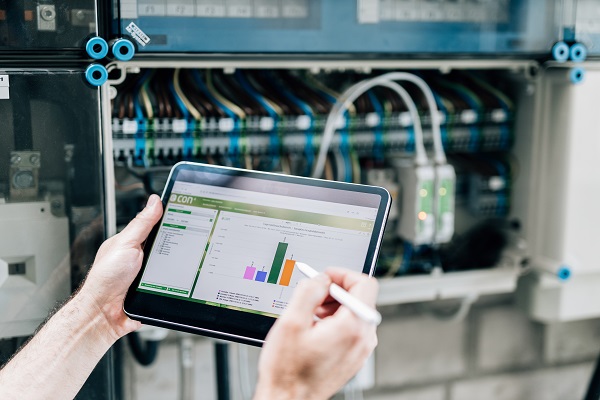
The econ energy management system is used to support this process.
This system digitally records key production facilities and monitors their energy consumption.
The analysis is based on:
- Measurement data
- Operating data
- system-specific consumption values
Data-Driven Optimization of Energy Efficiency
The data collected forms the basis for evaluating measures in investment planning, maintenance, and plant optimization.
As part of this process, we regularly assess whether technical modifications or the replacement of components can help improve energy efficiency. The assessment is conducted within the specific application context.
Analysis of Optimization Potential
In addition, potential for optimizing material usage and process control is analyzed. Any measures identified are implemented while taking into account technical and economic constraints.
Internal Material Recycling in Plastics Production
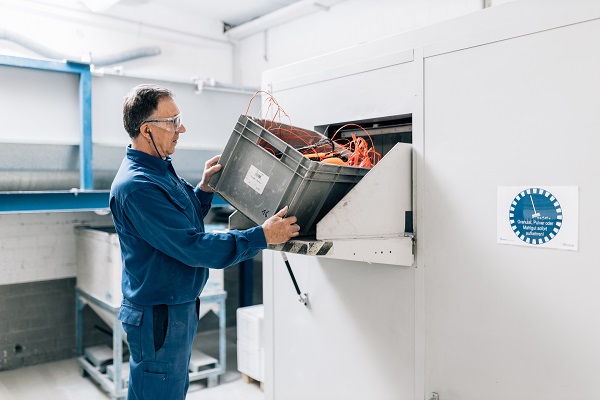
SITRAPLAS operates an internal recycling system to process suitable production waste.
Materials such as start-up waste, strands, oversize particles, and sprues are sorted by type and mechanically processed. The processed materials are tested in the company’s own laboratory and evaluated for relevant properties.
Where technically feasible, they are used in recompounds. Their specific application depends on the end use and quality requirements.
This recycling process in plastics production can reduce the use of virgin raw materials, depending on the application.
Energy Use in Production
Production uses electricity from renewable energy sources. The specific implementation depends on the location and the terms of the energy supply contract.
In connection with the electricity it uses, SITRAPLAS supports programs such as the EKOenergy label.
This label defines criteria for the origin of electricity from renewable sources and includes funding mechanisms for international environmental and climate protection projects.



Company
SITRAPLAS partners with you to produce individual resin compounds for state of the art product solution.